500 Startups Back Office Sexy Again
AARRR Framework- Metrics That Permit Your StartUp Sound Like A Pirate Ship

Today, September 19th, is International Talk Like A Pirate 24-hour interval, and thus, the perfect alibi to chat about one of the most important metric frameworks to live by equally a startup marketer or Growth Hacker: The AARRR framework.
ten+ years ago… wow, that's a long time agone.
ten+ years ago, Dave McClure, venture capitalist, angel investor, founder of startup accelerator 500 Startups and self proclaimed creep, introduced the globe to a v-step framework for growth. That framework was called AARRR, or also the Pirate Metrics.
Before we begin, more than of a video person? So spotter this weblog post below instead of reading information technology.
What is AARRR?
AARRR stands for Acquisition, Activation, Retention, Referral and Acquirement and is pretty much the bee'southward knees when it comes to agreement your customers, their journey and optimizing your funnel every bit well as setting some valuable and actionable metric goals for your startup.
Why AARRR?
AARRR is widely accustomed as the 5 most important metrics for a startup to focus on. That is because these metrics effectively measure your visitor'south growth while at the same time existence simple and actionable.
And then without farther ado, allow'southward begin.
- Conquering — "Where Are Our Users / Customers Coming From?"
Conquering, the outset A in the AARRR framework, describes how people find you and somewhen plough in to customers.
In the dating globe, acquisition would range from something like coincidentally meeting your time to come better one-half through a friend to wooing him/her into settling down with you (I'm sure your fantastic dancing skills played a part in this somewhere).
It's important to view the conquering part holistically.
That means not but looking at site visitors but also at how many and how those site visitors convert to customers. Yous desire to runway every step of your client journeying in the funnel non simply await at the concluding conversion to a paying customer. Every micro-conversion forth the way counts. To come up back to the dating analogy, the beginning time you lot said "I love you lot" counts too, not just the 24-hour interval yous got married.
Permit's expect at an example customer journey for a SaaS business organisation:
Website visit -> email signup -> webinar participation -> telephone call with sales squad -> conversion to customer.
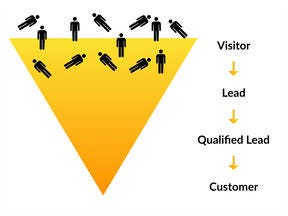
All those steps, before converting to a customer, count as micro-conversion and should exist measured to a) understand your customer's journey and b) optimize your customer's journeying. For SaaS and whatsoever other business that heavily relies on an active sales team information technology's besides of import to distinguish between a lead and a qualified lead.
A atomic number 82 is any company to your site who's contact information you've captured in some way. That can exist by e-mail accost or phone number. However, just considering someone signs up for your emails doesn't mean they are actually looking to purchase anything from you lot (right now). Maybe you lot offered a free due east-book or access to some sectional content they wanted and that'due south why they signed up. Maybe they just desire to stay in the loop considering they're interested in your product but the timing is not quite right yet. A lead shouldn't be viewed as someone who's purchase intentions are necessarily loftier yet.
Withal, if a atomic number 82 completes the next (or few next) micro-conversions in your customer journey, for case past watching a webinar on how to use your product or how your product solves a specific problem, you can consider them a qualified lead as they are actively engaged in vetting your product. That's when the sales team should come in as the lead now is "hot".
I besides want to take a second to talk about acquisition in the sense of getting eyeballs to your website. Many businesses, especially those that just offset out, struggle with getting traffic to their website or app. I strongly recommend utilizing The Bullseye Framework equally introduced past Gabriel Weinberg, founder of DuckDuckGo and author of Traction, at this stage.
The Bullseye Framework proposes that you look at all 19 channels that tin possibly drive traffic to your website or product, but after brainstorming every channel, focus on one channel and exam its success for your business in a modest scale version. If y'all see success, scale that aqueduct. If not, move on to testing some other channel. Information technology'due south basically an acquisition aqueduct testing version of the MVP process.
Weinberg states that for every business organization at different stages of growth one singular channel will be the main traffic commuter. So find that channel and tweak every part of your advice until y'all encounter explosive (or something like it) growth. If every traction channel fails, there's likely something incorrect with your product/marketplace fit.
Three fundamental questions you want to be asking yourself nearly your acquisition:
- What channel is driving the almost traffic (#)?
- What channel is driving the most valuable traffic, in other words, performs all-time (%) in terms of client conversion?
- What channel has the lowest customer acquisition cost ($), i.eastward. cost per client converted?
I would like to stop my recommendation to apply The Bullseye Framework with the words of Peter Thiel, early Facebook investor and PayPal founder:
"Information technology is very likely that one channel is optimal. Almost businesses really get zero distribution channels to work. Poor distribution — not product — is the number one cause of failure. If you can go fifty-fifty a single distribution channel to work, y'all have great business. If y'all try for several only don't boom one, you're finished. So it's worth thinking really difficult virtually finding the single all-time distribution channel."
More on Gabriel Weinberg'southward BullsEye Framework volition come up in a separate mail service. Till so relish this.
ii. Activation — "How good is the user's / customer's first experience?"
The way I similar to apply AARRR'due south Acquisition and Activation part overlap a piffling. I volition explain my reasoning for this below then comport with me.
Activation is about the first experience your customer has with your production. It is non enough to become people to download your app and/or even sign up, if they are going to stop using the app right later. That's why information technology'southward crucial to go your user to the "Aha Moment", which is the first time the user realizes the existent value in your product, as quickly as possible so that he/she keeps coming back. The time between when the user signs upward and when he says "Holy cow, I dear this", that is activation in a nutshell.
The reason I similar to include customer conversion under acquisition and differentiate information technology clearly from activation is considering someone that signs up for your service is converted as a customer but they might not necessarily exist using it. This has to be looked at differently for every type of business organization.
For an e-commerce business, activation is less important subsequently conversion but more so after a micro-conversion, e.g. they sign upwards for your emails etc. You should await at how much content visitors are consuming and how they are consuming, for instance on your website, and optimize their experience. Activation I would say is less important for east-commerce businesses compared to apps and SaaS businesses.
For an app, you lot should look at activation later on people download / sign up for your app. Do they log-in once and never come up dorsum?
For a SaaS business concern, you desire to look at the moment people beginning using your platform. You could think of the moment they sign up for your trial (or fifty-fifty full service) as the moment of acquisition. Every effort after that should be geared towards successfully activating your customer. SaaS businesses usually give extensive on-boarding support and provide an account manager / customer success manager (or whatever you lot desire to telephone call it) to walk you through the platform and prove some standard solutions to get y'all started.
In other words, an activated customer is someone who keeps coming back to use your production. Facebook realized early on in their growth that the "Aha Moment" for a user occurred when they acquired vii friends in x days, which is why they synced your email account with Facebook to suggest friends.
Twitter realized that one time you followed xxx people you were more likely to come back and then they suggest popular accounts when you sign up. Dropbox saw that users who uploaded at least one file were much more likely to apply Dropbox once more and so, y'all guessed information technology, they encourage you to upload a file during signup.
Again, to go users to the "Aha Moment" as quickly as possible y'all want to make sure the on-boarding process is as seamless and enjoyable every bit possible. And then of course you lot want to examination, test, examination till you observe your magic metric like Twitter, Dropbox and Facebook did and build your on-boarding process effectually it.
To turn your "common cold customers" into ones that actively utilize your product it's a good idea to segment and start targeting these users with specific on-boarding emails. You lot should also specifically deport customer interviews with these "cold customers" to understand why they signed up but are not using your product.
3. Retention — "How many of your customers are you retaining and why are you losing the others?"
If in that location was a church of marketing then I'd definitely be the preacher of retention. Customer retention is the offset thing I look at when I am evaluating not just a company's marketing efforts merely their unabridged product success.
Memory means people regularly come back to use your product. For an east-commerce business that ways someone not but buys from you once but multiple times. For an app, that means that users go along coming dorsum and opening / using the app. For a SaaS business, that ways that people who are subscribed to your software keep using it (oftentimes) and stay subscribed.
The contrary of customer retention would be client churn. It is so incredibly important to measure your customer churn charge per unit, I cannot emphasize it enough.
For 1, your churn rate will tell y'all if y'all have achieved a good product/marketplace fit. If a lot of people are dropping off your production after they start using information technology and so clearly something might exist wrong with either your product or your messaging. In the words of Bill Gates :"Your virtually unhappy customers are your greatest source of learning".
Second, you want to make sure that your customer churn rate is lower than your customer acquisition rate. A lot lower. Considering that'south the only way to achieve growth. You lot can think of it like a leaky saucepan, it doesn't matter how much water you pour into it (how many customers yous acquire) the bucket won't get fuller (your company won't achieve growth) because it is leaking water at the bottom (your customers are churning).
Customer Acquisition Rate > Customer Churn Rate = Growth
Customer Churn Charge per unit > Client Acquisition Rate = Burning a lot of money
Third, according to Harvard Business organization Review information technology'south 5 to 25 times more expensive to acquire a new client than to retain an existing one. Information technology'south as well easier to sell to someone who has purchased from you before every bit trust between you has already been established. Therefore, it is a lot cheaper and easier to cantankerous-/up-sell or sell again to a client y'all've already acquired before than to a "stranger".
So how can you increment client memory?
The easiest mode is to go on a nice share of mind of your customers past staying in touch. Email automation is a cracking method for this.
four. Referral — "How can you plough your customers into your advocates?"
The accented best way to drive growth is through referral. Why would yous spend big sums of money on marketing to people'south deaf ears if you lot tin just have people they trust rave about your product to them.
To really drive referrals yous need to have a systematic process in place that incentivizes and generates them on a consistent footing.
Dropbox figured that out early and their referral plan was one of the principal drivers of their growth.

Hotmail essentially congenital its own referral program without the user even consciously knowing by including "Get a gratuitous eastward-postal service account with Hotmail" in every email that was sent from a Hotmail accost.

Ii metrics you want to keep a close eye on for referrals are the Internet Promoter Score (NPS), an alphabetize that ranges from -100 to 100 and measures how willing customers are to recommend your visitor'south products or services. Information technology lets yous know how satisfied and loyal your customers are to the brand.

Some other metric to pay attention to is the Viral Coefficient. The viral coefficient is the number of users a client refers to you. A viral coefficient of ii would mean that ane customer on average refers 2 new customers to you. Your viral coefficient needs to exist larger than one to have growth. The following graph shows y'all the exponential user growth you can have depending on your viral coefficient, i.e. the number of people one client refers to you.

In the words of the president, it's yuge! Yous tin can see that an incremental increase of One thousand from 1 to 1.1 does wonders for your growth already and is really the driver behind virality. And isn't that what every business organisation wants: To become viral?
5. Revenue — "How can you increment revenue?"
If y'all've optimized co-ordinate to the iv AARR metrics before, revenue should already be flowing in nicely. And no affair what anyone tells you, acquirement and figuring out a monetization plan is important for any startup. Fifty-fifty Facebook and Instagram, companies that started out equally pure social, not-monetary platforms, are only successful today considering of the huge advertizing business behind them.
So what's the best way to increase revenue? Past increasing your Client Lifetime Value (CLV) and decreasing your Customer Conquering Cost (CAC).
Your client lifetime value is the amount of revenue you lot earn from a customer during their lifetime or rather the lifetime equally a customer of your company.
Your client acquisition cost (CAC) is the amount of coin you spend on acquiring your customer. That includes price for marketing, sales, meetings, fancy dinners or whatever it takes to go your customer to convert. A good ratio of CLV to CAC for growth is 3:ane.
To reduce your customer conquering cost you should optimize your sales funnel.
To summarize, the AARRR framework is the simplest and virtually effective manner to wait at optimizing your business and measuring growth.
Every metric has deeper layers to information technology and I encourage you to expect further into optimizing each.
___________
Melanie Balke
CEO & Founder, The E-mail Marketers
Read more good stuff at The Email Marketers
Interested in my favorite marketing-related books? Bank check out:
- Traction by Gabriel Weinberg
- Abracadabra by Rory Sutherland
- Trust me I'k lying by Ryan Vacation
Source: https://ms-mbalke.medium.com/aarrr-framework-metrics-that-let-your-startup-sound-like-a-pirate-ship-e91d4082994b

Postar um comentário for "500 Startups Back Office Sexy Again"